New
Delhi, April 2026.
The
COAI DigiCom Summit 2026,the 2nd of the DigiCom Series by COAI, commenced
today with Government officials, regulators and industry leaders calling for a
secure, resilient and innovation-driven digital ecosystem, underpinned by
next-generation telecom networks and emerging technologies such as Artificial Intelligence
and 5G.
The
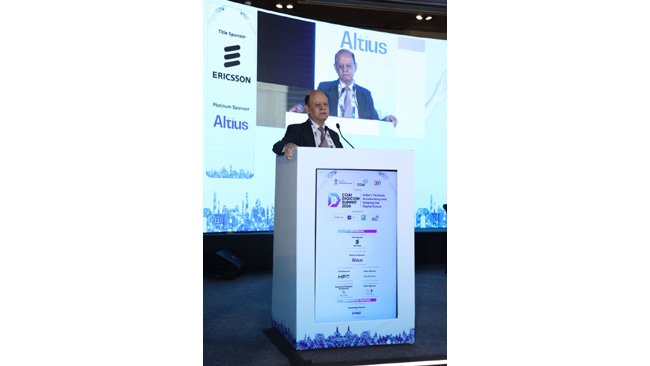
event kickstarted with the inaugural session which witnessed participation from
key leaders from the Government and Industry, including the Chief GuestDr.Pemmasani
Chandra Sekhar, Hon’ble Minister of State for Communications and Rural
Developmentalong with ShriAnil Kumar Lahoti, Chairman, TRAI; Mr. Abhijit
Kishore, CEO, Vodafone Idea and Chairperson, COAI; Mr. Julian Gorman, Head of
APAC, GSMA; Mr. Nitin Bansal, Managing Director, Ericsson India; Mr. Ashwani
Khillan, Chief Operating Officer, Altius Telecom Infrastructure Trust; Mr. Rahul
Vatts, Chief Regulatory Officer, Bharti Airtel and Vice Chairperson, COAI; as
well as Lt. Gen. Dr. S.P. Kochhar, Director General, COAI.
The
Summit, themed “India’s Techade: Accelerating and Shaping the Digital
Future,” has brought together policymakers, telecom operators, global
technology leaders, academia and innovators to deliberate on key challenges and
opportunities shaping India’s digital trajectory. The event is positioned as a
high-level platform to align policy direction, industry priorities and
technological advancements in building a future-ready digital ecosystem.
In his
inaugural address, Hon’ble Minister of State for Communications, Dr.Pemmasani
Chandra Sekhar, expressed,“India’s telecom sector stands at an
inflection point, shaped by strong Government policy support and industry-led
investments. Over the last decade, we have seen a transformative journey driven
by reforms in spectrum management, right of way and a modern regulatory
framework. This progress reflects a partnership between theGovernment and the Industry,
enabling scale, affordability and global competitiveness. The industry has
responded with massive investments, including a rapid 5G rollout in just 22
months and one of the highest data usage levels globally. I request operators
and manufacturers to focus on design-led manufacturing, build export-grade
testing and certification facilities, and form joint ventures with global
technology leaders for design, IP and talent development. As AI, 6G, and Quantum
Communications evolve, the next phase must focus on design-led manufacturing
and deeper R&D participation, so that India helps write global standards.”
Shri
Anil Kumar Lahoti, Chairman, TRAI said, “India’s telecom
sector has, over the years, delivered connectivity at a scale and affordability
that is globally unparalleled. This achievement has been possible due to a
combination of progressive policies, regulatory certainty and sustained
investment by the industry. Over the last 10 years, the mobile network has
grown more than 4.5 times and today, includes one of the largest 5G
deployments. While capacity augmentation continues, availability of ubiquitous
coverage is increasingly the expectation of consumers. Our ongoing efforts
include recommending spectrum enhancements, developing regulatory frameworks
for indoor connectivity and digital consent, and leveraging AI for spam
prevention to ensure robust infrastructure and consumer protection.”
Mr. Abhijit
Kishore, CEO, Vodafone Ideaand Chairperson, COAI said, “India’s
telecom sector continues to anchor the nation’s digital transformation through
connectivity at scale and globally unmatched affordability. Policy certainty
and regulatory stability remain critical, as long-term infrastructure
investments require a predictable framework that recognizes both capital
intensity and the sector’s strategic economic role, alongside continued
constructive engagement between the Government, the Regulators and the Industry.
Looking ahead, the sector must prepare for the next generation of connectivity,
where future technologies will demand not just technological readiness but also
alignment on standards, spectrum strategy and broader ecosystem development.”
Lt.
Gen. Dr. S.P. Kochhar, Director General, COAIexpressed,“Telecom
today is not just about connectivity; it is a value-added horizontal powering
sectors such as finance, healthcare, governance and enterprise. As we move into
the next phase of India’s digital journey, the focus must shift to building
intelligent, secure and resilient networks anchored in trust and collaboration.
This is the second edition of the DIGICOM summit. We have been able to curate a
unique event, and the best brains of the telecom industry have gathered to shed
light on how techade belongs to India."
Mr. Rahul
Vatts, Chief Regulatory Officer, Bharti Airtel and Vice Chairperson, COAI said,“We
are at a pivotal moment where trust, resilience and innovation are becoming
central priorities for the industry. There is clear recognition of the progress
made in strengthening the regulatory and policy environment. At the same time,
the industry remains committed to advancing R&D, enhancing customer
experience, and building more resilient networks. As AI begins to reshape the
sector, stakeholders are geared to adapt and lead this transformation.
Continued collaboration across the ecosystem will be critical in taking the
industry forward.”
Mr. Nitin
Bansal, Managing Director, Ericsson Indiaopined,“As India advances its digital journey, networks
must be secure, resilient and intelligent. The country has achieved one of the
fastest 5G rollouts, with strong infrastructure and high data consumption.
Going forward, 5G will act as critical infrastructure supporting advanced
applications. Technologies such as AI, cloud and 5G will drive digitalization,
with industrial automation emerging as a key opportunity. The focus now is on
building intelligent networks to support future growth.”
Mr. Julian
Gorman, Head of APAC, GSMA, highlighted India’s global role: “India’s digital transformation has reached a
decisive phase, with mobile networks enabling digital public infrastructure and
innovation at scale. However, for 6G leadership to be credible, 5G must evolve
beyond consumer speeds into an engine of industry transformation. With nearly
47% still offline, closing the usage gap and building trust will be critical to
achieving inclusive and globally competitive digital growth.”
Mr.
Ashwani Khillan, Chief Operating Officer, Altius Telecom Infrastructure Trust
said, “India’s digital transformation is the outcome of a strong and
well-aligned ecosystem, where progressive policy, a dynamic operator landscape
and robust telecom infrastructure have worked in tandem over the last three
decades. From enabling seamless digital services like UPI and e-commerce to
building one of the world’s largest 5G networks, the sector has fundamentally
reshaped how India lives and works. Looking ahead, as technologies like AI and
6G take shape, telecom infrastructure will remain central to powering the next
phase of inclusive, digital growth for the country.”
Discussions
during the inaugural session focused on key themes including artificial
intelligence-led networks, tackling spam and digital fraud, advancing 5G and
preparing for 6G technologies, and strengthening digital infrastructure and
manufacturing ecosystems.The DigiCom Summit 2026 features multiple sessions on
network resilience, regulatory frameworks, next-generation connectivity and
digital infrastructure, with participation from policymakers, industry leaders
and global experts over the course of the day.

© 2019 All Rights Reserved | democraticjagat2019 | Developed By DIIT IT SERVICES & SOLUTIONS