New Delhi, February 2026.
The
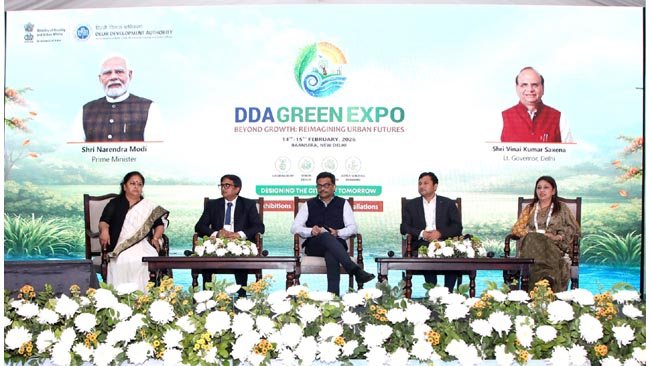
two-day DDA Green Expo 2026 concluded yesterday at Baansera with a powerful
consensus among policymakers, urban planners, climate experts, industry leaders
and grassroots environmentalists that India’s cities must move beyond
conventional growth models and embed ecology, resilience and sustainability at
the core of urban development.
Held
under the theme “Beyond Growth: Reimagining Urban Futures”, the Expo
brought together a diverse range of voices to explore how nature-based
infrastructure, climate-responsive design, public health integration, circular
economy models and innovative financing can collectively shape the future of Indian
cities.
The
Expo opened with the inauguration ceremony and welcome address, as well as
unveiling of the DDA Green Logo and Yearbook, by N. Saravana Kumar, Vice
Chairman, Delhi Development Authority. This was followed by an impactful
keynote address from Hon’ble Lieutenant Governor of Delhi and Chairman of
the Delhi Development Authority, Vinai Kumar Saxena.
The
inauguration was followed by the signing of 5 key Memorandums of Understanding
(MoUs) with Delhi Technological University, Mathura-Vrindavan
Development Authority, National Medicinal Plants Board, National
School of Drama and WWF-India, aimed at strengthening research,
ecological restoration, cultural engagement and citizen participation.
Across
the two days, seven panel discussions addressed some of the most pressing urban
challenges. These included Building Climate-Ready Cities Through
Nature-Based Infrastructure, focusing on floodplains, wetlands and
biodiversity corridors as essential urban systems; Responding to Urban
Heat: Policy, Planning & Public Health, examining heat resilience
as a recurring urban emergency; and Designing for Climate-Responsive
Cities, which explored sustainable and energy-efficient urban design.
The
conversation expanded into resource efficiency through Cross-Sector Collaboration
for Urban Food Circularity, highlighting waste reduction and
sustainable food systems, while Day Two opened with Development vs
Conservation: Finding a Middle Path, addressing the balance between
urban expansion
and
ecological protection. Financing sustainable cities took centre stage in Financing
Green City – CSR & PPP for Sustainability, exploring green bonds,
carbon markets and blended finance, before concluding with From Talk to
Transformation, which focused on translating policy intent into
on-ground implementation.
Complementing
the panels were four masterclasses on Solar Innovations for Urban
Infrastructure, Urban Gardening & Sponge City, Water
Management Systems, and Carbon Sequestration, offering
practical demonstrations of scalable climate solutions.
A
special fireside chat titled Nature, Health and Behaviour Change: Healing
Cities from the Ground Up featured environmentalist Swami Prem
Parivartan (Peepul Baba) and Ramveer Tanwar, popularly known as the Pond
Man of India, emphasising community-driven ecological restoration and
individual responsibility in building resilient cities.
Throughout
the Expo, experts consistently reinforced that ecological systems must be
treated as core urban infrastructure. Discussions stressed the urgency of
preserving water bodies, restoring floodplains, rethinking land-use planning,
investing in climate finance and building institutional capacity to address
escalating climate risks.
The
closing session highlighted that collaboration across government, academia,
industry and civil society is essential to move from pilot initiatives to
large-scale, long-term urban transformation.
With
strong participation from policymakers, researchers, corporates, students and
citizens, the DDA Green Expo 2026 positioned itself as a landmark platform for
shaping climate-forward urban development in India, reinforcing Delhi
Development Authority’s commitment to creating a greener, healthier and more
resilient capital.
The
DDA Green Expo 2026 has firmly positioned Delhi as a climate-forward urban
laboratory, reinforcing that the future of Indian cities lies in aligning
ecological integrity, economic progress and citizen participation into a
unified, resilient development vision.

© 2019 All Rights Reserved | democraticjagat2019 | Developed By DIIT IT SERVICES & SOLUTIONS